

Thank you for visiting Bartle & Gibson. If you encounter any issues or have feedback to share, please email us at [email protected]. Your input is greatly appreciated!
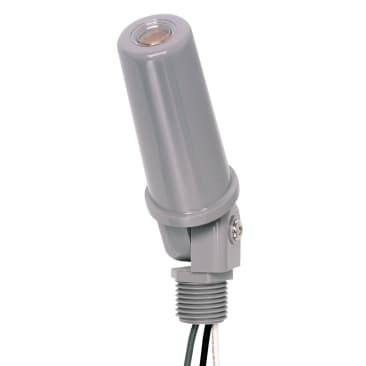
2000W 120V SWIVEL CYLINDER PHOTOCELL INTERMATIC K4251
Product Details
Attributes
Features
Resources
Intermatic® Thermal Photocontrol, Series: K4200, 120 V AC, 15 A, 50/60 Hz Frequency, 1800 W Tungsten, 1000 VA Ballast, SPST Contact Form, 30 to 90 s Timing, 18 AWG Wire, Cadmium Sulfide Sensor, 1 to 5 fc Turn On/3 to 15 fc Turn Off Sensitivity, Environmental Conditions: -40 to 158 deg F, Box/Fixture Mounting, Polycarbonate, Gray, 1-3/8 in Dia x 4 in H Dimensions
The K4200 Series Photo Controls feature stern and swivel mounting, with thermal-type controls. Thermal-type photo controls, which are available in single or multi-voltage models, provide dusk-to-dawn lighting control and a delay action, which eliminates loads switching OFF due to car headlights, and lightning. The thermal-type controls feature a cadmium sulfide photocell and a sonic-welded polycarbonate case and lens to seal out moisture. The design utilizes a dual temperature compensating bi-metal and composite resistor for reliable long life operation over ambient temperature extremes.
- Mechanical bimetal switch with Cadmium Sulfide photocell
- Delay feature prevents unwanted OFF switching
- High strength, UV resistant plastic housing
- Swivel with 1/2 in-14 NPSM threaded stem
Product Details
Intermatic® Thermal Photocontrol, Series: K4200, 120 V AC, 15 A, 50/60 Hz Frequency, 1800 W Tungsten, 1000 VA Ballast, SPST Contact Form, 30 to 90 s Timing, 18 AWG Wire, Cadmium Sulfide Sensor, 1 to 5 fc Turn On/3 to 15 fc Turn Off Sensitivity, Environmental Conditions: -40 to 158 deg F, Box/Fixture Mounting, Polycarbonate, Gray, 1-3/8 in Dia x 4 in H Dimensions
The K4200 Series Photo Controls feature stern and swivel mounting, with thermal-type controls. Thermal-type photo controls, which are available in single or multi-voltage models, provide dusk-to-dawn lighting control and a delay action, which eliminates loads switching OFF due to car headlights, and lightning. The thermal-type controls feature a cadmium sulfide photocell and a sonic-welded polycarbonate case and lens to seal out moisture. The design utilizes a dual temperature compensating bi-metal and composite resistor for reliable long life operation over ambient temperature extremes.
Attributes
Features
- Mechanical bimetal switch with Cadmium Sulfide photocell
- Delay feature prevents unwanted OFF switching
- High strength, UV resistant plastic housing
- Swivel with 1/2 in-14 NPSM threaded stem