

Thank you for visiting Bartle & Gibson. If you encounter any issues or have feedback to share, please email us at [email protected]. Your input is greatly appreciated!


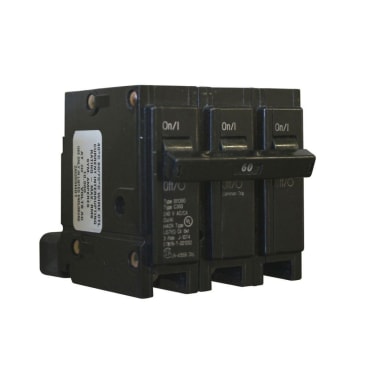
EATON BR360 BR 60A 3-POLE 10KAIC THERMAL MAGNETIC CIRCUIT BREAKER
Product Details
Attributes
Features
Resources
EATON Circuit Breaker, Type BR, 240 V AC, 60 A, 10 kA Interrupt, Thermal Magnetic Trip, 3 Pole, 3 ph, 4 to 1/0 AWG Wire, NEMA 1/4X/3R, Plug-On Mount, 600 to 750 deg C, 3 in L x 3 in W x 3 in H
Eatons BR circuit breakers are used in indoor and outdoor BR loadcenters, spa panels, meter breakers and sub panels. They are designed for a wide range of applications such as high short-circuit interrupt, series rating combinations with upstream main breakers, thermal magnetic, AFCI, GFCI, equipment protection and dual function AF/GF.
- and AF/GF designs
- Short-body design maximizes your space inside the loadcenter
- creating additional wire-way and gutter space for ease of installation
- Easy to read trip codes through improved LEDs and a clear test button increases your troubleshooting efficiency
- Improved AFCI and GFCI algorithms significantly reduce nuisance tripping
- resulting in less call backs
Product Details
EATON Circuit Breaker, Type BR, 240 V AC, 60 A, 10 kA Interrupt, Thermal Magnetic Trip, 3 Pole, 3 ph, 4 to 1/0 AWG Wire, NEMA 1/4X/3R, Plug-On Mount, 600 to 750 deg C, 3 in L x 3 in W x 3 in H
Eatons BR circuit breakers are used in indoor and outdoor BR loadcenters, spa panels, meter breakers and sub panels. They are designed for a wide range of applications such as high short-circuit interrupt, series rating combinations with upstream main breakers, thermal magnetic, AFCI, GFCI, equipment protection and dual function AF/GF.
Attributes
Features
- and AF/GF designs
- Short-body design maximizes your space inside the loadcenter
- creating additional wire-way and gutter space for ease of installation
- Easy to read trip codes through improved LEDs and a clear test button increases your troubleshooting efficiency
- Improved AFCI and GFCI algorithms significantly reduce nuisance tripping
- resulting in less call backs