

Thank you for visiting Bartle & Gibson. If you encounter any issues or have feedback to share, please email us at [email protected]. Your input is greatly appreciated!


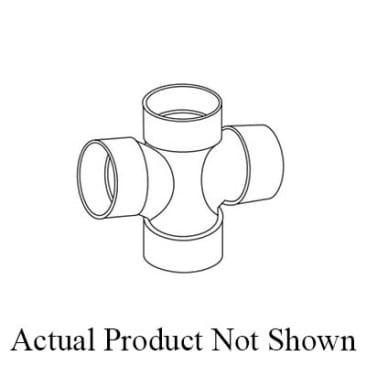
IPEX XFR 526539 3X2 HXHXHXH PVC CROSS
Product Details
Attributes
Features
Resources
System XFR® Reducing Double Sanitary Tee, Tee Fitting, 3 in Connection Size 1, Connection Type 1: Hub, 3 in Connection Size 2, Connection Type 2: Hub, Connection Size 3: 2 in, Connection Type 3: Hub, Connection Size 4: 2 in, Connection Type 4: Hub, Hub|Hub|Hub|Hub Connection, PVC, Material Construction: PVC, Dark Gray, SCH 40
Installed in a vertical System XFR piping system, this hub ended Tee creates a smooth transition from two horizontal branch lines.
- When tested to the CAN/ULC S102.2 Standard, System XFR achieved a Flame Spread Rating of not greater than 25 and a Smoke Developed Classification of not greater than 50
- Meets National and Provincial Building Codes for high buildings, air plenums, noncombustible construction and penetrating a rate fire separation
- High impact strength in cold temperatures, exceeding CSA requirements
- Improved flow rates
- Lower thermal conductivity can reduce or eliminate the need for insulation
Product Details
System XFR® Reducing Double Sanitary Tee, Tee Fitting, 3 in Connection Size 1, Connection Type 1: Hub, 3 in Connection Size 2, Connection Type 2: Hub, Connection Size 3: 2 in, Connection Type 3: Hub, Connection Size 4: 2 in, Connection Type 4: Hub, Hub|Hub|Hub|Hub Connection, PVC, Material Construction: PVC, Dark Gray, SCH 40
Installed in a vertical System XFR piping system, this hub ended Tee creates a smooth transition from two horizontal branch lines.
Attributes
Features
- When tested to the CAN/ULC S102.2 Standard, System XFR achieved a Flame Spread Rating of not greater than 25 and a Smoke Developed Classification of not greater than 50
- Meets National and Provincial Building Codes for high buildings, air plenums, noncombustible construction and penetrating a rate fire separation
- High impact strength in cold temperatures, exceeding CSA requirements
- Improved flow rates
- Lower thermal conductivity can reduce or eliminate the need for insulation