

Thank you for visiting Bartle & Gibson. If you encounter any issues or have feedback to share, please email us at [email protected]. Your input is greatly appreciated!
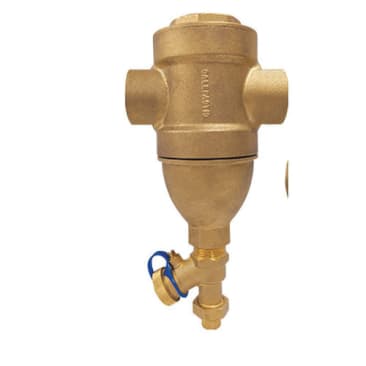
CALEFACTIO CXTD-125S-MAG 1-1/4IN SWT DIRT SEPARATOR WITH MAGNET
Product Details
Attributes
Features
Resources
Calefactio Dirt Separator, 1-1/4 in Nominal, Connection Type: Sweat, 150 psi, 250 deg F, Water and Glycol Solution Suitable Media, 50 % Maximum Percentage of Glycol, 16 gpm Flow Rate, Brass, 9.3 in H x 4.5 in W
The Cal-X-Tract dirt product from Calefactio reduce the risk of damage that could be caused by impurities in the systems of heating. They are equipped with a stainless steel coalescing media to catch the dirt particles without affecting the flow. The coalescence process produced by the media allows the dirt, they will merge with each other to then fall to the bottom of the separator to be drained. Their function allowing a better energetic performance while reducing the costly maintenance frequency. Their sturdy design allows to maintain their efficiency for whole duration of the system's lifetime. Models with a magnet facilitate the separation and accumulation of ferrous impurities thanks to their magnetic field. Some non-ferrous particles are also captured.
- Facilitates the separation and accumulation of ferrous impurities in the system
- Improves system efficiency
- Increases component life
- Eliminates annoying noises in the system
Product Details
Calefactio Dirt Separator, 1-1/4 in Nominal, Connection Type: Sweat, 150 psi, 250 deg F, Water and Glycol Solution Suitable Media, 50 % Maximum Percentage of Glycol, 16 gpm Flow Rate, Brass, 9.3 in H x 4.5 in W
The Cal-X-Tract dirt product from Calefactio reduce the risk of damage that could be caused by impurities in the systems of heating. They are equipped with a stainless steel coalescing media to catch the dirt particles without affecting the flow. The coalescence process produced by the media allows the dirt, they will merge with each other to then fall to the bottom of the separator to be drained. Their function allowing a better energetic performance while reducing the costly maintenance frequency. Their sturdy design allows to maintain their efficiency for whole duration of the system's lifetime. Models with a magnet facilitate the separation and accumulation of ferrous impurities thanks to their magnetic field. Some non-ferrous particles are also captured.
Attributes
Features
- Facilitates the separation and accumulation of ferrous impurities in the system
- Improves system efficiency
- Increases component life
- Eliminates annoying noises in the system